|
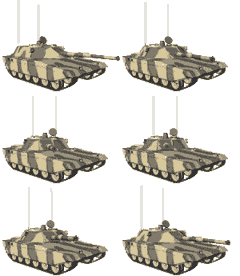
Modern Main Battle Tanks
This section
contains information about some of the modern Main Battle Tanks featured as variousn
products on Tankzone. Our aim is to build it up over time to be a useful reference
source for tank enthusiasts.
| British
Tanks | German
Tanks | US
Tanks | Tanks
from other countries | |
Centurion
- 1947
Chieftain - 1964
Challenger I
Challenger II |
| |
|
Modern
British Tanks From Centurion to Challenger 2
| Centurion |
The British Centurion
main battle tank was developed towards the end of the Second World War. Specification: |
| |
| Specification: | Abrams
M1A2 | | Country
of origin | UK |
| Crew: | 4:
Commander, Loader, Gunner and Driver | | Armament: | One
Rheinmetall smoothbore 120mm main gun, one M240 7.62 machine-gun co-axial with
the main gun, one M2 12.7 heavy machine-gun and one M240 7.62 anti-aircraft machine-gun
on turret roof. Multi-barrelled smoke discharger on each side of the turret. |
| Performance: | Road
speed: 41mph (67km/h), Range: 300 miles (480km),
Vertical obstacle: 3ft 6in
(1.07m), Trench: 9ft 0in (2.74m), Gradient: 60 degrees. |
| Powerplant: | Textron
Lycoming AGT-1500 gas-turbine engine developing 1,500hp at 30,000rpm. |
| Dimension: | Overall
Length: (hull) 25ft 11in (7.92m), (including main gun) 32ft 3in (9.83m), Width:
11ft 11in 3.66m, Height: 9ft 6in 2.89m. | | Combat
Weight: | 125,890lb
(57,154kg), 13.65lb/in2 (0.96kg/cm2) | | Brief
History | Prototype
began trials 1976, Production commenced 1980, Entered service with US Army 1980.
Currency users: US Army (8,444), US Marine Corps (403), Egypt (555), Kuwait (218),
Saudi Arabia (315).
Major Variants:
M1 (original base version)
-British Chobham armour. 105mm main gun.
M1 (improved version) - better armour.
M1A1 - 120mm smoothbore main gun, use of additional Depleted Uranium armour.
M1A2 - improved command and control, electronic, optical and electrical systems.
USMC version all have deep water fording kit. |
Modern
US Tanks From M26 Pershing to M1 Abrams
| M26
Pershing | Introduced
during the closing months of the Second World War, The M26 Pershing was originally
classified as a heavy tank but was reclassified after the war as a medium tank
when the US Army acknowledge that the M4 Sherman was no longer viable against
its modern counterparts like the German Panther. M26 Pershings were field alongside
the M4A3E8 Sherman during the Korean War against the Russian T34/85. |
| M46
Patton | Accepted
into service in 1948, the M46 Patton was essentially a rebuilt version of the
M26 Pershing with a new more powerful engine and a new transmission system to
improve maneoverability. This engine and transmission package would provide the
basis for US tank design for the next 35 years until the advent of the M1 Abrams
in 1981. About 2,400 M26 Pershing were rebuilt to the new M46 Patton standard
by 1951. Many saw action in the Koren War. The M46 Patton is distinguishable from
the M26 Pershing by presence of large mufflers on the rear fenders and addition
of a small return roller between the last road wheel and the drive sprocket. |
| M47
Patton | In
1948, the US Army initiated a programme to design the next generation of light
(76mm gun), medium (90mm gun) and heavy tanks (120mm gun). The light and medium
designs were known as T41 and T42 respectively. The T41 resulted in the M41 'Walker
Bulldog' which replaced the M24 Chaffee as the standard US light tank. However,
because of the frantic scramble to build tanks at the height of the Cold War,
it was decided to married the turret from the failing T42 prototype which has
a better layout onto a modified but well-proven M46 hull as a stop-gap to speed
up delivery. This new tank, with a host of other automotive improvements and in
particular animproved fire control system, was designated the M47 Patton. Production
began in 1951 but the haste and inadequate testing meant the M47 was plagued with
technical problems during its short service life. No M47 Patton served during
the Korean War. Though it had a relatively short life in the US Army, the M47
served in various NATO armies for nearly 15 years. | | M48
Patton | Work
on a replacement for the M47 began in December 1951. This new design retained
the same engine and transmission as the M47 but was otherwise a completely new
design with new turret and hull. Like the M47, over-hasty schedule without adequate
testing resulted in the first batch of M48 coming off the production line in April
1953 with serious technical problems. The M48 was distinguishable y its distintive
round turret. ABout 3,200 M48 were built.
Variants:
M48A1 - Identical
to M48 except for a completely enclosed cupola housing the ,50-cal machine gun
previously exposed.
M48A2 - This version addressed the M48A1's greatest tactical
deficiency with its short range of only 112km with a new fuel injection engine
and a larger fuel tank beneath a new rear engine deck which also reduced its infra-red
signature. The M48A2 became the standard US medium tank of the late 50s and 60s.
Nearly 12,000 were built by the time production ceased in 1959.
M48A2C - Improved
fire control system and the deletion of a small return roller between the last
road wheel and the drive sprocket.
M48A3 - Rebuilt M48A1s with improvement
from the M60 programme and the new engine deck and improved fire controls of the
M48A2C. A host of other minor improvements resulted in the M48A3 (Late Model).
M48A4 - Originally intended to refer to M48A3s with M60 105mm gun turrets released
by the M60A2 programme, delay to this programme due to this beiing cancelled but
the designation was used for administrative purpose to refer to the Israeli-modernised
M48A2s with improved engine and 105mm gun provided by the US.
M48A5 - Until
production of the new M60 has ramped up sufficiently, it was decided to upgrade
all mothballed M48s, M48A1s etc. to M60 standard by a variety of packages. These
upgraded tanks were designated M48A5s.
M88 - Armoured recovery vehicle version
of the Patton.
XM246 - Entering service in the mid-80s, essentially a M48A5
with a new turret mounting twin 40mm Bofor cannons and a fire control radar for
anti-aircraft defense. | | M60
Patton | Design
began in 1956 when the arrival of the Soviet T54 prompted the requirement for
a heavier main gun from the standard 90mm medium tank main gun of the time. Again
because of the pressure to react to the new threat and the fact that the M48 series
is so well established, it was decided to upgun the M48 from 90mm to the new British-designed
L7 105mmb and designated this new tank the M60 Patton. The M60 Patton also contain
a whole series of improvements from the automotive system to the fire control
system.
Variants:
M60A1 - New version featuring a new larger
turret allowing more ammunition to be stowed. A new more powerful engine was added
to handle the additioanl weight. The M60A1 also introduced a gun stabilisation
system which enable the main gun to stay in the general direction of the target
no matter which direction the tank was travelling in. Infra-red night sights were
also added which necessitate the addition of a large Xenon serchlight above the
main gun. Nearly 8,000 M60A1 were produced by the end of 1981.
M60A2 - Attempt
to marry the Shillelagh 152mm gun/missile launcher system to the proven M60 hull
to produce a lighter, more easily transportable vehicle, to counter the threat
of improved Soviet armour in Europe.
Resulted in a completely new long narrow turret on esentially the same hull. The
plan was to upgrade all M60A1 to this new system but the new gun never lived up
to the expectations of the planner and and only 526 units were built between 1973
and 1975. It was completed withdrawn from service in 1980. The 60A2 turrets being
removed and scrapped and replaced with the M60A1 version.
M60A3 - Latest version
of the M60 with improvement to all areas that will provide a capable main battle
tank well into the 21st Century. New equipment includes aaser range-finder, a
computerised fire control system together with thermal imaging aiming and tracking
system, improved weapon stabilising system, a cross-wind sensor and a thermal
sleeve for the main 105mm gun. All M60s are being replaced with M1s in the US
inventory but still serves with many armies all over the world.
M728 - Combat
Engineer Vehicle.
G2 - Armoured Vehicle Launched Bridge. |
Top
of Page
Modern
US M1A1/A2 Abrams MBT
| Specification: | Abrams
M1A2 | | Country
of origin | USA |
| Crew: | 4:
Commander, Loader, Gunner and Driver | | Armament: | One
Rheinmetall smoothbore 120mm main gun, one M240 7.62 machine-gun co-axial with
the main gun, one M2 12.7 heavy machine-gun and one M240 7.62 anti-aircraft machine-gun
on turret roof. Multi-barrelled smoke discharger on each side of the turret. |
| Performance: | Road
speed: 41mph (67km/h), Range: 300 miles (480km),
Vertical obstacle: 3ft 6in
(1.07m), Trench: 9ft 0in (2.74m), Gradient: 60 degrees. |
| Powerplant: | Textron
Lycoming AGT-1500 gas-turbine engine developing 1,500hp at 30,000rpm. |
| Dimension: | Overall
Length: (hull) 25ft 11in (7.92m), (including main gun) 32ft 3in (9.83m), Width:
11ft 11in 3.66m, Height: 9ft 6in 2.89m. | | Combat
Weight: | 125,890lb
(57,154kg), 13.65lb/in2 (0.96kg/cm2) | | Brief
History | Prototype
began trials 1976, Production commenced 1980, Entered service with US Army 1980.
Currency users: US Army (8,444), US Marine Corps (403), Egypt (555), Kuwait (218),
Saudi Arabia (315).
Major Variants:
M1 (original base version)
-British Chobham armour. 105mm main gun.
M1 (improved version) - better armour.
M1A1 - 120mm smoothbore main gun, use of additional Depleted Uranium armour.
M1A2 - improved command and control, electronic, optical and electrical systems.
USMC version all have deep water fording kit. | Top
of Page
Modern
JGSDF Type 90 MBT
| Specification: | Type
90 MBT | | Country
of origin | Japan |
| Crew: | 3:
Commander, Gunner and Driver | | Armament: | One
automatic loading Rheinmetall smoothbore 120mm main gun, one 7.62 machine-gun
co-axial with the main gun, one 12.7 heavy machine-gun on turret roof. One triple-barrelled
smoke discharger on each side of the turret. | | Performance: | Road
s peed: 43mph (70km/h), Range: 250 miles (400km), Vertical obstacle: 3ft 2in (1m),
Trench: 8ft 10in (2.7m), Gradient: 60 degrees. | | Powerplant: | Mitsubishi
10ZG 10 cylinder water-cooled diesel engine developing 1,500hp at 2,400rpm. |
| Dimension: | Overall
Length: (hull) 24ft 7in (7.5m), (including main gun) 32ft 0in (9.76m), Width:
11ft 3in (3.43m), Height: 7ft 8in (2.34m). | | Combat
Weight: | 110,000lb
(50,000kg), 12.6lb/in2 (0.89kg/cm2) | | Brief
History | Prototype
began trials 1982, Production commenced 1991, Entered service with JGSDF 1992,
About 180 in service by 2000. |
Top of Page
Modern
German Leopard 2A5 MBT
| Specification: | Leopard
2A5 MBT | | Country
of origin | German |
| Crew: | 4 |
| Armament: | One
Rheinmetall smoothbore 120mm/L44 main gun, one MG3 7.62 machine-gun co-axial with
the main gun, one MG3 7.62 machine-gun on turret roof. Eight single-barrelled
smoke grenade launchers on each side of the turret. | | Performance: | Road
s peed: 45mph (72km/h), Range: 310 miles (500km), Vertical obstacle: 3ft 7in (1.1m),
Trench: 9ft 10in (3m), Gradient: 60 degrees. | | Powerplant: | MTU
MB-873 Ka-501 4-stroke, 12-cylindere, liquid-cooled, exhaust supercharged diesel
developing 1,500hp at 2,600rpm. | | Dimension: | Overall
Length: (hull) 23ft 7in (7.72m), (including main gun) 32ft 8in (9.97m), Width:
12ft 3in (3.74m), Height: 8ft 8in (2.64m). | | Combat
Weight: | 131,614lb
(59,700kg), 12.6lb/in2 (0.89kg/cm2) | | Brief
History: | Prototypes
1990, Upgrade programme started 1995. In service with Germany (225), Netherlands
(180), on order for Sweden (120) and Spain (219). |
Modern
German Gepard Anti-Aircraft Tank
| Specification: | Gepard
| | Country
of Origin | Germany |
| Crew: | 3:
Commander, Gunner and Driver | | Armament: | Two
35mm cannons and four smoke dischargers | | Performance: | Speed:
65 km/h, Range: 550 km | | Powerplant: | Diesel
engine develolping 830 hp at 2,200rpm. | | Dimension: | Overall
Length: 7.68 m, Width: 3.27 m | | Combat
Weight: | 47,000
kg | | Brief
History: | A
variant of the Leopard 1 MBT. |
Top of Page
|
|