|
The Tank Story - The Beginning
The Landships Committee
- The idea of an armoured
tracked vehicle that would provide protection from machines gun fire was first
proposed by Colonel Earnest Swinton based on his observation of trench warfare.
- Rejected
by the Army, his proposal was sent to Winston Churchill, the then navy Minister,
who set up the Landships Committee in February 1915 to study the possibility of
breaking the trench deadlock by creating a 'Trojan Horse' for transporting soldiers
into enemy lines.
- This
Committee went beyond this original concept thought to be impractical and together
with the newly formed Inventions Committee, produced a specification for an armed
vehicle and fighting platform.
- The
specification included: (1) a top speed of 4 mph on flat ground - the speed of
marching infantry; (2) the capability of a sharp turn at top speed; (3) a reversing
capability; (4) the ability to climb a 5-foot earth parapet; (6) the ability to
cross a 8-foot gap; (7) a vehicle that could house ten crew, two machine guns
and a 2-pounder gun.
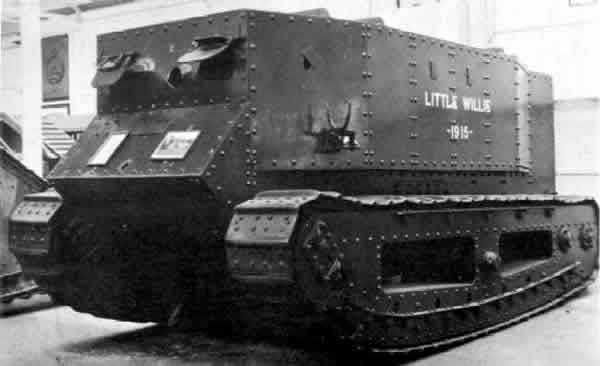
Little
Willie 'Little
Willie' - The
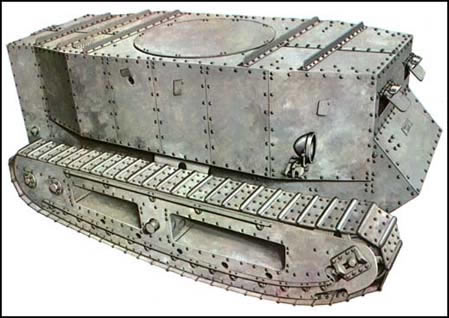
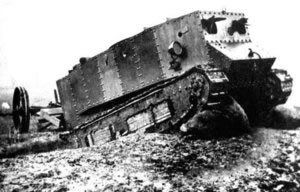
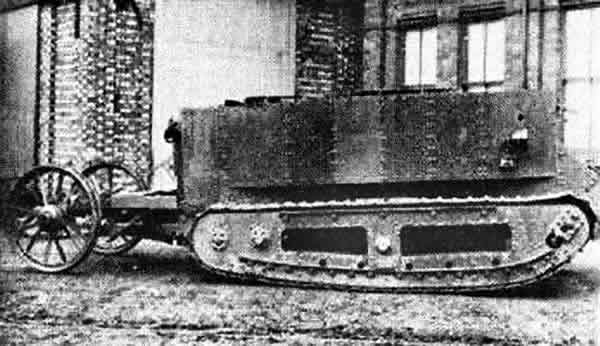
first prototype completed in December 1915 was an unarmed tracked vehicle called
'Little Willie'.
- Already
it embraces all the principles of later tanks such as tracks running the whole
length of a fully-armoured body.
- A
revolving gun turret was envisaged but this was dropped when it would make the
already 10 foot tall vehicle too high.
- 'Little
Willie' was 12 feet long and weight 14 tons. It had a crew of three and a top
speed of 3.5mph on road and half that across country.
- It
was apparent that 'Little Willie' was fine as a test bed but a new design, already
in development, was needed to turn it into a fighting vehicle.
Big
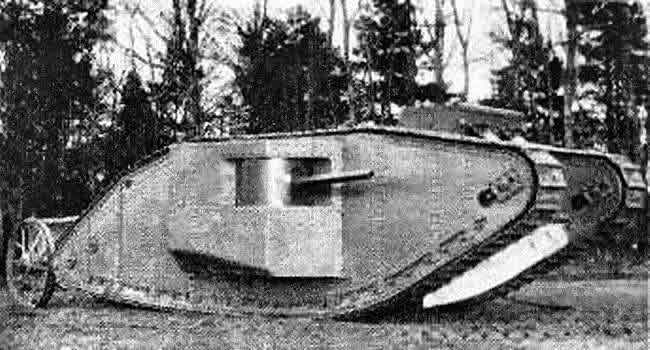
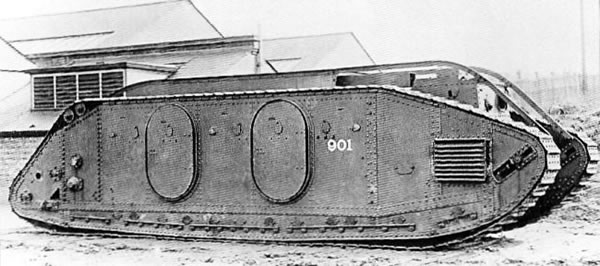
Willie or Mother - The second
design and prototype, called 'Big Willie' or simply 'Mother', was completed soon
after 'Little Willie'.
- Based
on a rectangular box hull similar to 'Little Willie' sandwiched by more radically
rhomboidal shaped track frames that carry the tracks right round the hull. A set
of rear wheels or limber trailing the main body was used to help with steering.
It ran for the first time on January 1916.
- 'Big
Willie' had a crew of eight; four to operate the tank (driver, gearsman, 2 brakesmen)
and four to operate the armament (2 gunner, 2 machine-gunners/loaders). It had
10mm of frontal, 8mm of side armour and can travel at just under 4mph.
- Because
of the already considerable height, the rotating turret idea was dropped in favour
of 'sponsons' blistered into the sides of the hull carrying the main armaments;
twin 6-pounder or 57mm guns sourced from the Navy. It was intended that these
sponsons can be removed from the production model for transport.
Males,
Females & Hermophrodites - During
the design stage, there was some doubt expressed as to whether gun-armed vehicles
would be able to hold off attack by massed infantry so it was decided that half
of the production would be 'females' carrying .303 inch Vickers machine guns in
place of the 6-pounder guns on the 'males'.
- The
female was armed only with machine guns and was intended for attacking enemy personnel
and light fortifications. The male was armed with machine guns and two 6-pounder
naval guns. The intention of the male was to attack other gun emplacements and
strong points.
- When
the German start to deploy their own captured tanks in April 1918, some 'females'
were fitted with a male sponson containing a 6-pounder gun on the right side so
that they can defend themselves. These conversions were known as 'hermophrodites'.
The
Advent of the Tank - A
new unit known for security reasons as the Heavy Section, Machine Gun Corps. Was
formed to man these vehicles in May 1916.
- Though
originally called 'The Landship', for security reasons, these vehicles were designated
'Mobile Water Tanks' for desert warfare during manuafacturing and shipped to France
from England labelled as 'Water Tanks' thus giving them the name by which they
have been known ever since.
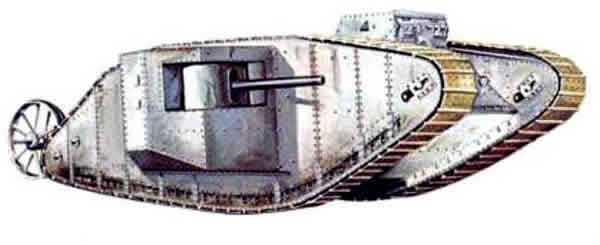
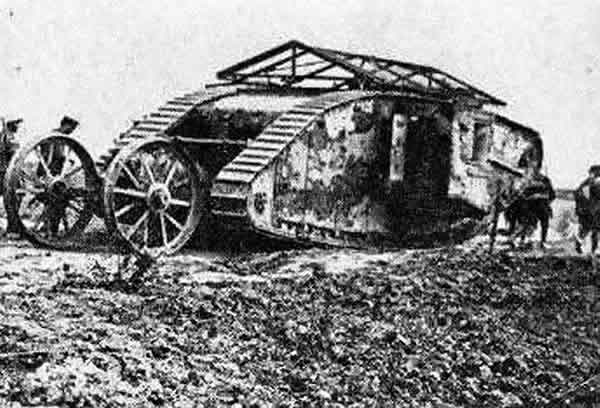
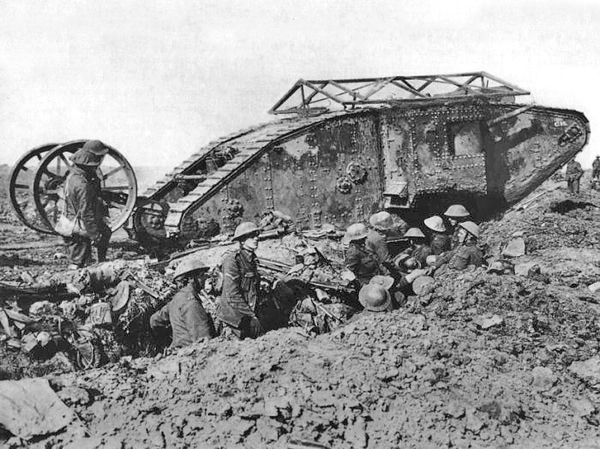
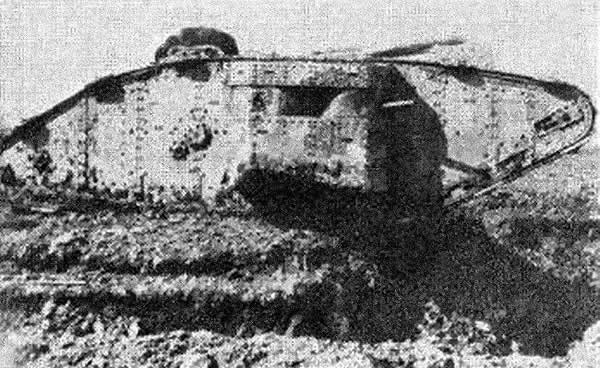
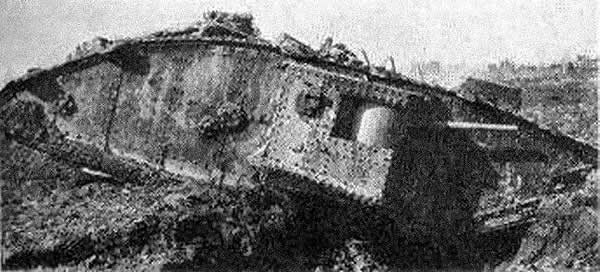
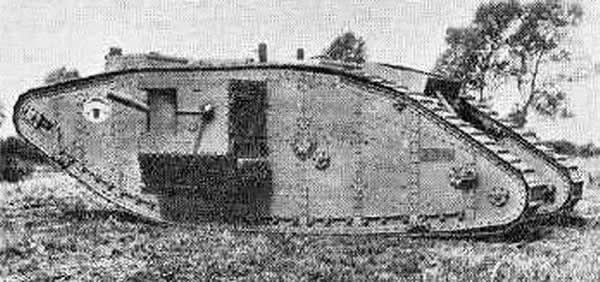
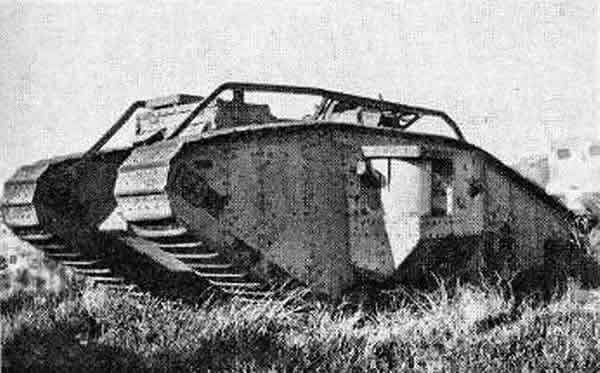
Mark
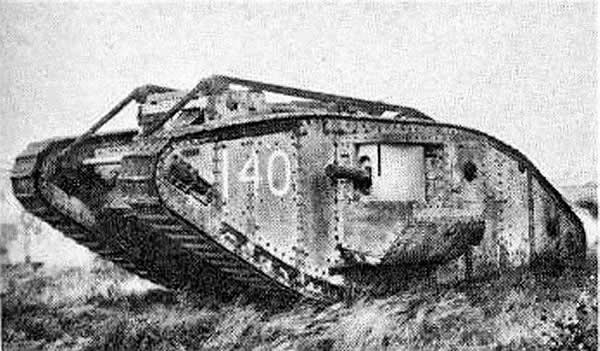
1 to Mark III Tanks - After
successful trials of 'Big Willie' during the early part of 1916, one hundred (later
increased to 150) of what would become known as the Mark I tank were ordered for
deployment in France. Half was to be completed as 'males' and half as 'females'.
- No lights were
fitted inside the Mark I tank and ventilation was poor. The tracks did not have
suspension or any mean of shock absorption. The resulting noise, smoke and heat
within the gloomy and confined interior produced an extremely exhausting fighting
environment for the crew. Communications between crew members were only possible
by hand signals.
- Significant
improvements to overcome these deficiencies and also as a result of combat experience
were introduced in the subsequent Mark II and Mark III. Otherwise they were identical
except for minor changes. Frontal armour was increased to 12mm to overcome German
armour-piercing bullets.
- The
rear steering wheels proved impossible to use in comabt and was discarded from
November 1916.
- Mark
II Improvements included a wider track link in every 6 to increase movement performance
on soft ground.
- Mark
III Improvements included a raised manhole hatch on the top of the hull and late
production vehicles has a smaller sponson and a lower calibres and therefore shorter
6-pounder gun as was later fitted in the Mark IV.
- Production
of Mk. I, Mk. II and Mk. III tanks were limited to 200. 100 were Mark Is, 50 Mark
IIs and 50 Mark IIIs.
Mark
I Specification
| Crew: | 8
(4 to operate the tank and 4 to operate the armaments) | | Armament:
| (Male) 2 x
40 calibres 6-pounder guns, 4 x 8mm Hotchkiss machine-guns. (Female) 4 x .303in
Vickers machine-guns, one 8mm Hotchkiss machine-gun. The female sponson was slightly
larger than the male. | | Armour:
| 10mm frontal
(increased to 12mm from Mk. II onward to overcome German armour-piercing bullets),
8mm side (increased to 10mm). 6mm top and rear. | | Dimensions:
| Length 32ft
6in, width 13ft 9in (male) 14ft 4in (female), Height 8ft half inch. |
| Combat Weight: | 62,720lb
(28,450kg) for male, 60,480lb (27,434kg) for female. | | Engine:
| Daimler six-cylinder
inline water-cooled patrol engine developing 105hp at 1,000rpm. |
| Performance:
| Speed
3.7mph (6.95km/h), range 23.5 miles (37.8km), vertical obstacle 4ft 6in (1.35m),
trench crossing 11ft 6in (3.45m), gradient 24 percent. | Mark
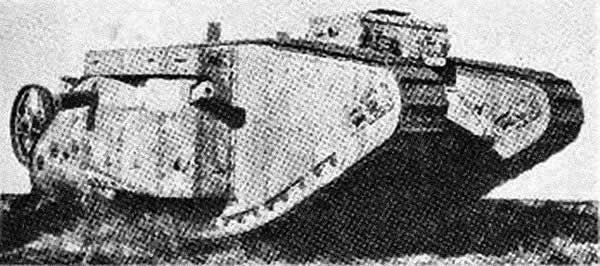
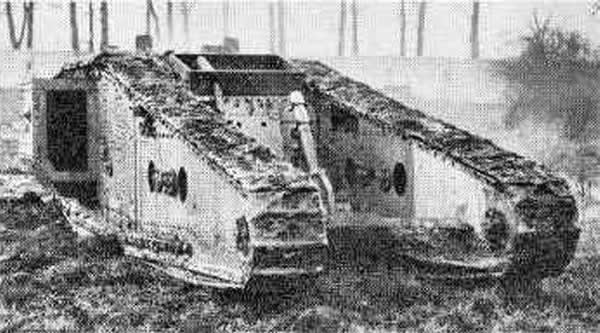
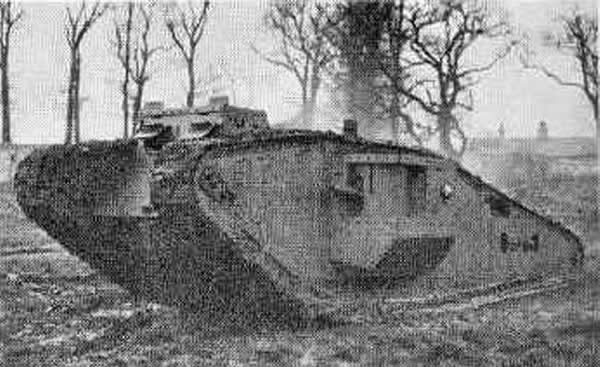
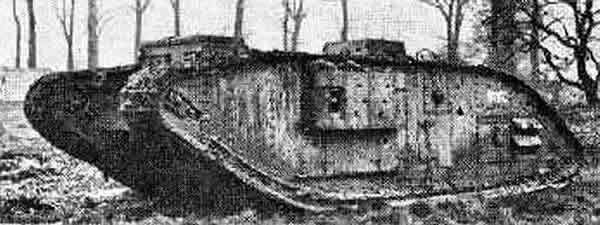
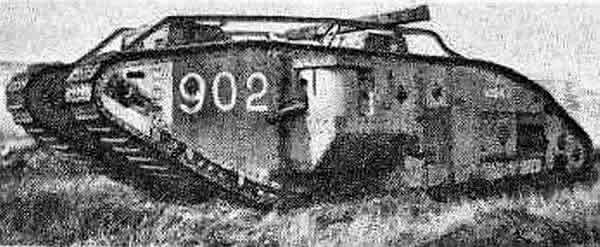
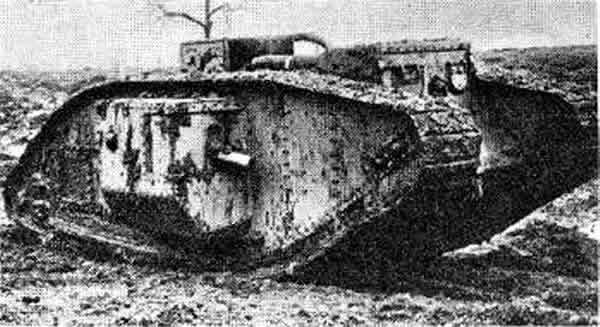
IV Tank - The
Mark IV is perhaps the best known of the First World War Tanks.
- The
Mark IV retained the same classic Rhomboidal shape and incorporates the improvements
made since Mark I through Mark II and Mark III resulting in a much improved and
more effective fighting vehicle.
- Outwardly
the Mark IV appears little different to its predecessors but there were many detailed
changes.
- The
crew compartment was better ventilated and extra escape hatches were fitted to
the roof as well as the sides.
- A
silencer was fitted to the exhaust to reduce the noise level inside. Engine power
was up-rated but still underpowered and the fuel system improved. Range was increased
by more patrol being carried in armoured tanks outside of the top of the hull
toward the rear.
- Running
gears were strengthened in key places and the tracks widened with studs added
to some track links to improve traction.
- A
rectangular unditching beam used to overcome obstacles was carried as standard
on top of the tank along a new set of rails.
- Mark
IVs have lower 23 calibres (from previously 40 calibres) main guns with shorter
barrels to eliminate the danger of the muzzle being dug into the ground when crossing
wide trenches.
- Both
the male and female sponsons were redesigned to stop the botton leading edage
catching when passing over rough ground.
- For
a time, .303in Lewis machine-guns were installed due to shortage of the Hotchkiss
Machine-gun. The wide cooling jacket around the Lewis guns proved to be susceptible
to small arms fire and also requires larger holes to be cut into the armour.
- The
sponsons on Mark IVs were hinged to allow them to be swung in for transport.
- The
Mark IV became the workhorse of the tank corps from September 1917 to the end
of the war. 420 male and 595 female Mk. IVs were produced in total.
- Some
Mark IVs were fitted with an extended 9 feet 'tadpole' tail to increase the trench-crossing
ability.
Mark
IV Specification
| Crew: | 8
(same arrangement as previous marks) | | Armament:
| (Male) 2 x
23 calibres 6-pounder guns, 4 x .303in Lewis machine-guns. (Female) 6 x .303in
Lewis machine-guns. (Lewis machine-guns replaced by Hotchkiss 8mm machine-guns
in later Mark IVs) | | Armour:
| 14mm frontal,
12mm side. 8mm top and rear. | | Dimensions:
| Length 26ft
5in, width 13ft 9in, Height 8ft 2 inch. | | Combat
Weight: | 62,720lb
(28,450kg) for male, 60,480lb (27,434kg) for female. | | Engine:
| Daimler six-cylinder
inline water-cooled patrol engine developing 125hp. (150bhp in later Mark 5s) |
| Performance:
| Speed
3.7mph (6.95km/h), range 35 miles (56km), vertical obstacle 4ft 6in (1.35m), trench
crossing 10in (3.0458), gradient 24 percent. | Mark
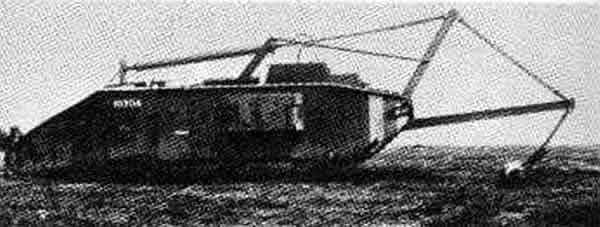
V to Mark IX Tanks - The Mark.
IV was followed by five later marks of the now familiar Rhomboidal or lozenge-shaped
tank but only the Mark V was produced in any significant quantity.
- The
Mark V was an improved Mark IV and it was the first heavy tank that could be driven
by one man without the need for others to work the gears and brakes through a
new drive and gear system.
- Some
Mark Vs were fitted with an extended 'tadpole' tail to increase the trench-crossing
ability similar to the Mark IVs.
- Many
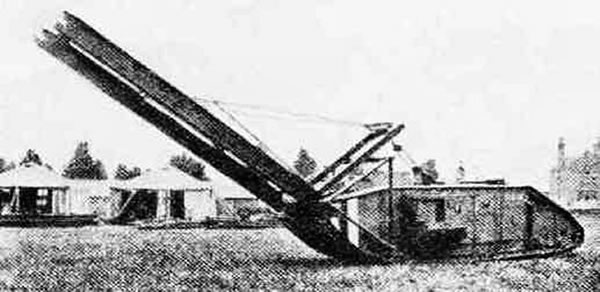
variants of the Mark V were developed to fulfil various roles on the battlefield
including carrying supply, recovery of damaged tanks, bridge laying, mine clearing
and laying fascine to allow wide trenches to be crossed. In
total, 200 male and 200 female of the various Mark 5 variant was produced.
- The
Mark V* was a widen version introduced in 1918 that can carry an additional 24
infantrymen. 200 male
and 432 female of the Mark 5* variant was produced.
- There
were also Mark V** and Mark V*** variants but few were built and none were introduced
to combat.
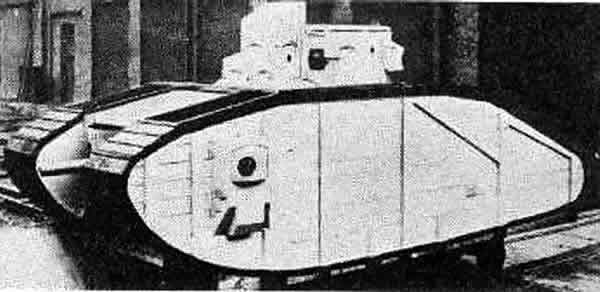
- The
design of the Mark VI was a radically departure from previous heavy tanks. It
was smaller, lighter and faster and the main 6-pounder gun was to be located low
and front of the hull. Five machine-guns were to be installed in support two of
which were in small side sponsons. Only a mock-up of this vehicle was ever produced.
- The
Mark VII was an experimental design. It was the first to have an electric starter.
Only one was ever produced.
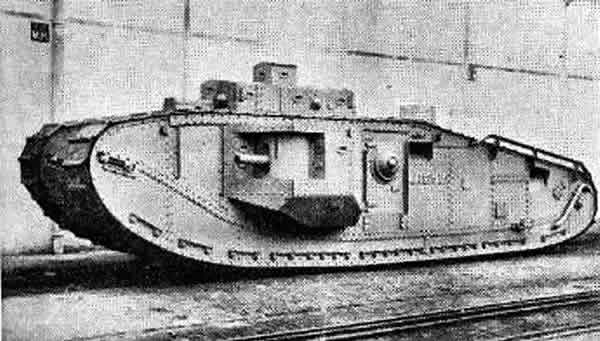
- The
Mark VIII began life as a joint venture between Britain, France and the United
States of America to supply 1500 tank to the new United States 'Tank Corps' being
established in the Summer of 1917.
- By
the time all the fine details were agreed on, the war ended and the French left
the partnership. Only a few prototypes was completed. The
United States decided to go ahead anyway and produced 100 Mark VIIIs alone.
- The
Mark VIII was referred to the Anglo-American or Liberty tank. It was was an enlarged
and improved version of the rhomboid-type heavy tank, with better track, greater
trench-crossing ability, and a powerful Ricardo or Liberty V-12 engine in a sealed
engine compartment generating 300/340 bhp. It carried a crew of 11.
- The
Mark VIII remained in service in the U.S.A. until the mid 1930s undergoing various
upgrades during it's life to improve and extend it's service capabilities. This
was perhaps the best design to emerge from the series.
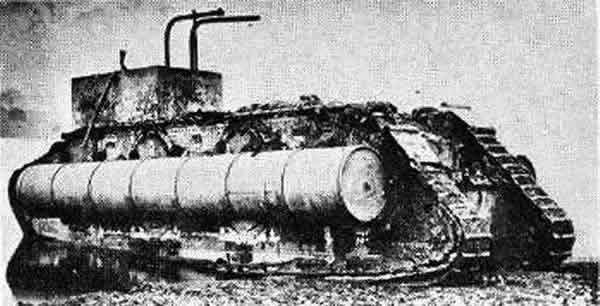
- The
Mark IX was designed to be an infantry supply vehicle rather than a fighting machine
and due to its ungainly appearance became known as 'The Pig'.
- 'The
Pig' was large enough to carry 50 men or 10 tons of equipment. Plans for 200 were
called for buy only 23 were ever made. The machine had large side doors and a
large load area but was very underpowered and suffered from poor performance.
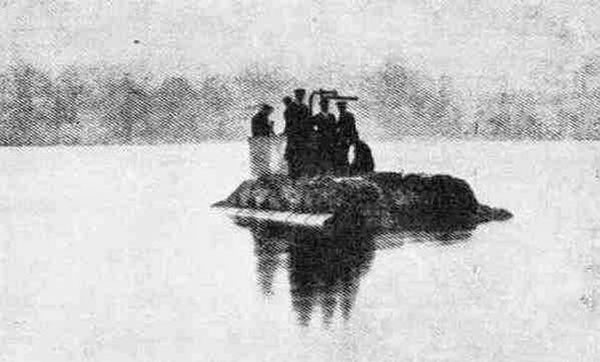
- In 1919, one
'Pig' was made amphibious and called 'The Duck', by adding a raised cab, flotation
devices, and a modified exhaust. Propulsion was provided by a motor at the rear
and paddles attached at various intervals on the tracks.
- By
1919 these large, heavy, slow-moving and vulnerable vehicles were obsolete and
were replaced by lighter and faster models.
First
Tank Deployment - Tanks
as we know it today in the form of the Mark Is were first deployed in anger in
September 1916 by the British.
- Original
plan was to deploy the tanks in a massed attack to achieve surprise and to maximise
its shock value.
- It
was instead thrown into action in panic at the fast deteriorating situation with
the bogged-down Somme offensive
- Out
of an initial force of 50 tanks, only 36 made it to the start line due to mechanical
failures and other defects.
- Only
a very few of the original force reached their objectives but those that did keep
going, swept all opposition before them.
- Despite
an inauspicious beginning, the observing army staff was sufficiently impressed
to instigate ordering 1,000 of the new fighting vehicle thus safeguarding the
role of the tank on future battlefields.
Do you find this useful?
Email us your feedback. What else would you like to see?
Top of Page
|
|